"Raised in the last 90 days" is not a TAM filter
Fit decides who belongs in the market. Timing decides who goes first. Using a recent fundraise as a total addressable market filter drops perfect-fit accounts out of view.
Leadership often asks the outbound team to “only target companies that raised recently.” The request sounds like a way to focus capacity on companies that might buy soon. In practice, it shrinks the total addressable market (TAM) every time a timing idea feels urgent.
A company that fits your ideal customer profile, has the problem you solve, and has not raised in the last 90 days drops off the list. That account was a justified target last month. It will be one again when a timing signal appears. In the meantime it is invisible, and you cannot prioritize someone you already filtered out.
The Orchestra Unified GTM Methodology treats that request as a scoring signal, not a TAM filter. Fit defines membership in the market. Timing reshuffles order.
Why do teams treat a recent raise as a market filter?
Funding is easy to see, and easy to put in a list-building query. “Raised in the last 90 days” feels precise. It also feels current, which is why it shows up in leadership reviews when pipeline is thin and a new initiative needs a tighter target.
The cost shows up later. Perfect-fit accounts without a recent raise never enter the market. When leadership later asks the team to prioritize healthcare, or when a hiring spike or an inbound event would have raised an account in the order, that account is not there to be reordered. A new spreadsheet gets built, with a new timing rule, and the market shrinks again.
Most go-to-market organizations already run several versions of the market. Each sales development representative may build a list every morning. Marketing keeps a separate ABM file. Last quarter’s strategic accounts live in a downloads folder. When timing is used as a membership rule, those private lists multiply, and nobody can answer how big the market is without three conflicting numbers. A common sign of trouble is that “TAM” secretly means “who raised recently.”
The methodology’s name for this mistake is “timing mistaken for TAM.” It shrinks the market and excludes durable fit. Market size stops being a real number, and coverage stops being measurable. The team also keeps paying the tax of rebuilding the market for every initiative.
What is the difference between qualification and prioritization?
Qualification answers one question: is outreach justified at all? The answer is binary. An account is in the market or it is out.
Prioritization answers a different question: among qualified accounts, who goes first? The answer is a relative rank.
| Qualification | Prioritization | |
|---|---|---|
| Question | Is outreach justified at all? | Among qualified accounts, who first? |
| Answer shape | Binary in / out | Relative rank |
| Typical mistake | Using timing as a TAM filter | Treating fit as the only ranker |
If leadership says the TAM should only include companies that raised in the last 90 days, that is a scoring signal. A perfect-fit company that has not raised recently is still in market. They may simply be lower priority this week.
Broad sourcing filters that gather a suspected market are a different step from binary qualification. Filters can be wide. Qualification is the standard that says outreach is justified. Mixing a timing query into that standard is how a filter meant to find companies becomes a rule that excludes them.
Using timing as a TAM filter is the typical qualification mistake. Treating fit as the only ranker is the typical prioritization mistake. Both distinctions are load-bearing. If go-to-market language blurs them, the system will too.
How should fit and timing work together?
Fit is durable ideal customer profile (ICP) alignment: industry or use-case, size band, tech posture, and problem presence. Timing is why-now: funding, hiring spikes, leadership change, inbound engagement, or competitor evaluation.
High fit with high timing is the best prospect. High fit with low timing is still valuable. Low fit with high timing is usually a distraction. Urgency without alignment burns capacity and attention. Timing elevates the right accounts. It does not redefine who you sell to.
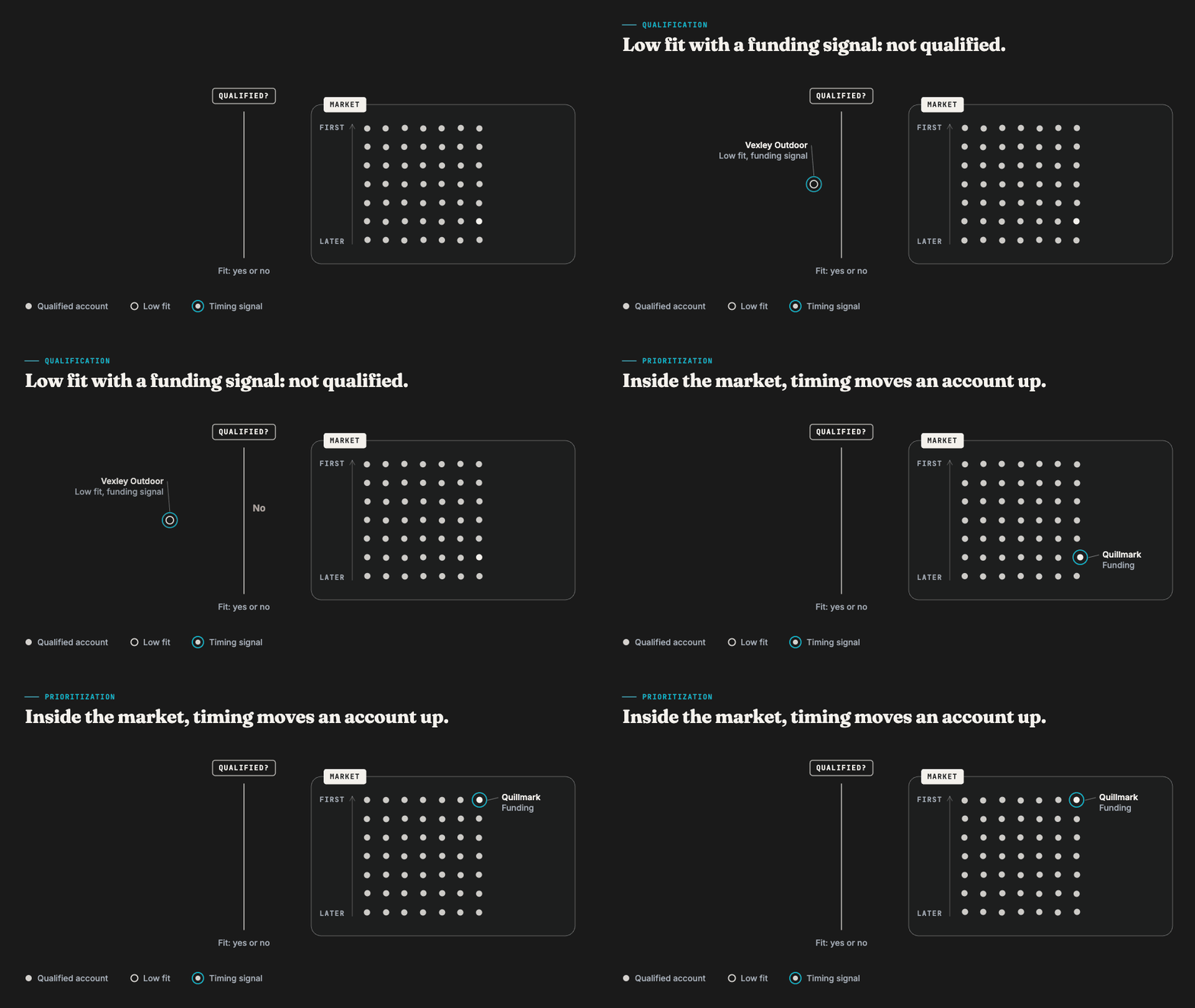
Watch the live qualification GIF

The motion graphic shows the same split. A low-fit account with a funding signal reaches a qualification gate and is turned back. Inside the market, a funding signal moves an already qualified account up the order. Timing never lets an unqualified account in, and a lack of timing never pushes a fitted account out.
“Usually a distraction” is the wording on purpose. Low fit with high timing is not an absolute ban. The default is still to protect capacity from urgency that has no alignment.
Where do timing signals belong?
Put timing signals into the score. Keep the market stable, and refresh it on a cadence.
TAM consolidation means building one total addressable market per segment, qualified once, maintained centrally, and refreshed on a deliberate cadence. New initiatives adjust priority inside that market. They do not spawn a parallel TAM, and campaign lists are not a second market.
A score’s job is to order the market. When a funding event, a hiring spike, or an inbound form-fill lands on an already qualified account, that account can rise in the same queue. When the signal cools, the account can settle without being deleted. Mid-signal events raise priority without waiting for the next campaign kickoff.
Deliverability and sending capacity still decide how many people you can contact today. Scoring and messaging decide who and what. Timing can move an account up the queue. It should not change the size of today’s batch, and spare mailbox capacity should not pull low-fit accounts into the market just because there is room to send.
Timing changes the order. It never changes whether someone may be contacted. That second question is eligibility, and it stays separate from score.
Score orders the market. Eligibility decides whether someone may be selected now. A contact can score in the top tier and still be blocked by a do-not-contact, a suppression list, no safe send path, or a policy of “not now.” Do not fix that by zeroing the score and pretending the model ranked them poorly. Keep attractiveness separate from permission. Do-not-contact and suppression stay outside the score, so reporting stays honest and operators can see why someone is not selectable today without rewriting history.
How does Orchestra qualify a market?
Orchestra builds and runs cold outbound programs for B2B companies. When we qualify the market with a client, we write a binary standard for whether outreach is justified, separately from the broad sourcing filters that gather a suspected market. Qualification criteria are written configuration. The market is assembled from qualified lists, then maintained as one canonical TAM per segment.
People set the standard, sample and validate it, and keep the market current. The system ranks that already-qualified market, applies eligibility, and cuts today’s batch by capacity.
The same method is written in full in the Orchestra Unified GTM Methodology.